If you source shower heads, the “best” material depends on the component. ABS suits light, complex handhelds; brass suits load-bearing threads; stainless steel suits slim rain plates and metal finishes. The strongest commercial design is often a tested hybrid.
Quick Answer: Choose by Component, Not by Label
A shower head is rarely one material. Its body, face plate, threaded insert, seals, nozzles and finish can each use a different material.
For buyers, the useful question is not “plastic or metal?” It is “which material belongs in each part, for this market and price point?”
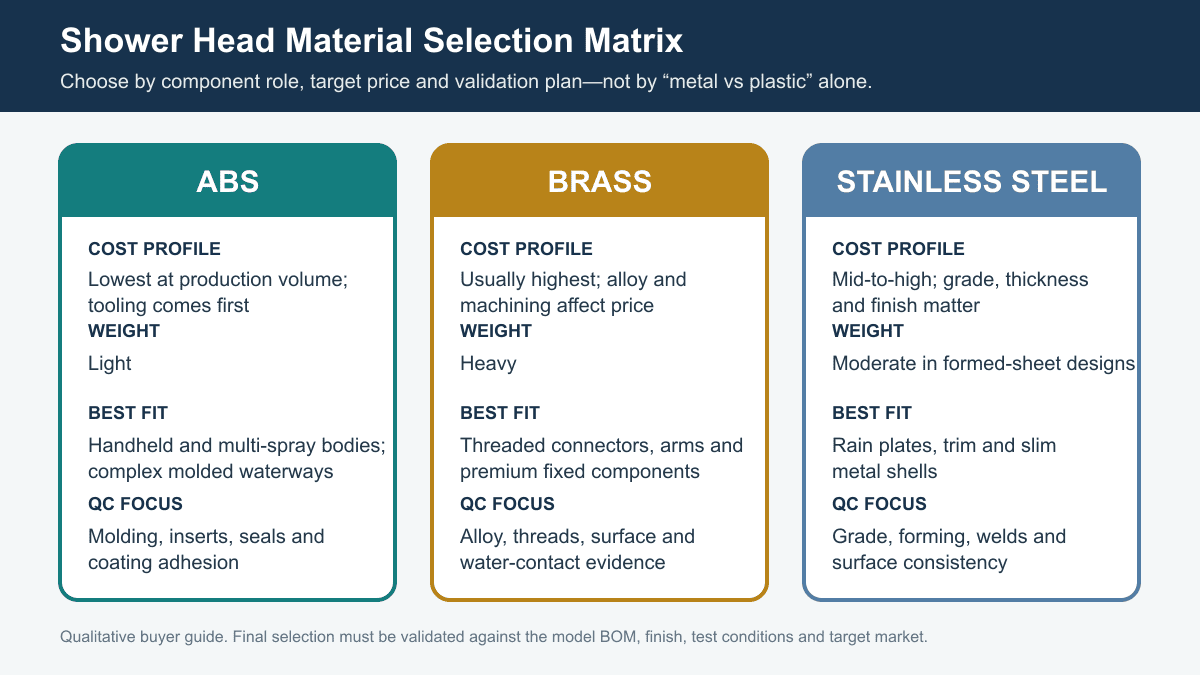
| Lēmuma faktors | ABS dušas galva | Brass shower head | Stainless steel shower head |
| Relative unit cost | Usually lowest at production volume; mold investment comes first | Usually highest because of alloy, casting or machining | Mid-to-high; strongly affected by grade, thickness and finish |
| Svars | Gaisma | Smags | Moderate in formed-sheet designs |
| Dizaina brīvība | Excellent for complex shapes and multi-spray waterways | Good for compact, strong machined or cast parts | Strong for flat plates, trim and slim shells |
| Tipiska loma | Handheld bodies, multi-function bodies and holders | Threaded fittings, arms, joints and premium fixed components | Rain plates, trim, shells and selected fixed heads |
| Main quality risk | Molding, inserts, seals and coating adhesion | Alloy choice, threads, surface quality and water-contact evidence | Grade, forming, welds and surface consistency |
ABS Shower Heads: Best for Light, Complex, High-Volume Designs
ABS, or acrylonitrile butadiene styrene, can be injection molded into curved shells, internal waterways and spray-mode structures that would be expensive to machine from metal.
An EU Joint Research Centre preparatory study reported that 90% of showerhead and hand-shower housings in its technical dataset were ABS. That finding explains why ABS is normal construction, not automatically a low-quality shortcut.
- Choose ABS for handheld units where low weight improves comfort and reduces load on the hose and holder.
- Use it when your range needs multiple spray modes, distinctive shapes or several color options.
- Budget for tooling, insert control, sealing and surface finishing—not just resin cost.
Chrome-plated ABS can create a metal appearance, but the finish becomes a quality-critical layer. Inspect for pinholes, blistering, thin edge coverage, color variation and poor adhesion.
Brass Shower Heads: Best Where Threads Carry Load
Brass is a copper-zinc alloy that machines cleanly and supports precise threaded connections. Its weight can communicate solidity, but it also raises material, shipping and handling costs.
A brass shower head makes the most sense when mechanical strength at a connector, arm, swivel or fixed body is more important than handheld comfort.
- Specify the alloy or accepted material standard instead of writing only “solid brass.”
- Confirm which parts are brass: the complete body, threaded insert, swivel, arm or decorative shell.
- Test thread fit, sealing faces and installation torque on the approved production sample.
Do not assume higher material cost guarantees a better product. Poor machining, an unsuitable finish or inconsistent sealing can still create leaks and after-sales claims.
Stainless Steel Shower Heads: Best for Slim Metal Forms
Stainless steel works especially well for broad rain-shower plates, thin shells and exposed trim. It can be brushed or polished without hiding the underlying metal.
The phrase “stainless steel shower head” is incomplete. Your specification should identify the grade, component, thickness, forming method, weld condition and surface treatment.
- Choose formed stainless steel when a large, slim profile is part of the design brief.
- Check flatness, edge finishing, weld quality and consistency between visible surfaces.
- Validate corrosion resistance on the finished assembly, not only on a raw material sample.
For finish planning, compare your options with our guide to popular shower head finishes.
Hybrid Construction Often Gives Buyers the Best Balance
A smart BOM assigns each material a job. You might combine an ABS body, a stainless face plate, an elastomer nozzle field and a metal threaded insert.
| Buyer program | Praktisks sākumpunkts | Kāpēc tas ir piemērots |
| Mass retail or private label handheld | ABS body with controlled coating and a validated threaded insert | Low weight, design freedom and scalable molding |
| Large rain shower | Stainless face plate or shell with engineered internal waterways | Slim geometry and an authentic brushed or polished surface |
| Premium fixed installation | Metal connector or arm with the body material selected by shape and finish | Strength is concentrated where installation loads occur |
| Multi-function handheld | Molded ABS structure with soft nozzles and tested seals | Complex channels without excessive weight |
What B2B Buyers Should Verify Before Sample Approval
Material names alone do not control quality. Your golden sample and purchase specification should connect the BOM to measurable inspection points.
- Confirm the BOM: record the material and grade for the body, face plate, connector, insert, nozzles, seals and decorative parts.
- Approve the finish: define color, gloss, texture and the accepted sample under controlled lighting.
- Check interfaces: verify threads, sealing faces, hose connection, holder fit and installation torque.
- Testa funkcija: document pressure, flow, leakage, spray pattern and switching checks with stated conditions.
- Review surface durability: agree on coating adhesion, abrasion or salt-spray evidence appropriate to the finish and market.
- Protect the shipment: confirm trays, bags, separators and carton strength so the visible surface arrives undamaged.
mūsu rūpnīcas pārskats lists injection molding, salt-spray testing and water-pressure testing among our public capabilities. Exact methods and acceptance limits should still be agreed for your model.
FAQs about ABS, Brass, and Stainless Steel Shower Heads
Is ABS a good material for a shower head?
Yes. ABS is well suited to lightweight handheld bodies and complex molded structures. Quality depends on resin control, wall design, inserts, seals and the applied finish.
Is a brass shower head always more durable?
No. Brass can strengthen threaded or load-bearing components, but durability still depends on alloy choice, machining, sealing, finish, installation and water conditions.
Is 304 stainless steel better than brass?
Neither is universally better. Stainless steel often suits thin plates and visible metal surfaces. Brass often suits machined threads and compact fittings. Compare the actual component and duty.
How can you tell whether a “metal” shower head is really metal?
Ask for a component-level BOM and drawing. “Metal” may describe only a cover, face plate or connector while the internal body remains molded polymer.
Build the Right Shower Head with Leelongs
We have supplied shower products since 2001 and support OEM and ODM projects with samples, drawings, custom finishes, packaging and product testing within our capabilities.
Pārlūkot mūsu shower head range, Tad sazinieties ar mums with your target market, quantity, material preference, finish and benchmark sample. We can review the most practical material split for your RFQ.