A concealed shower system puts the valve and pipework behind the finished wall. The visible result is simple; the performance depends on how the valve, trim, outlets, wall depth, and water supply work together. Here are the facts that explain that relationship.
What is actually concealed?
The valve body receives hot and cold water inside the wall. The trim plate and handle remain visible. Water then travels to a fixed head, hand shower, or tub spout through concealed pipework. A diverter, where fitted, determines which outlet receives water.
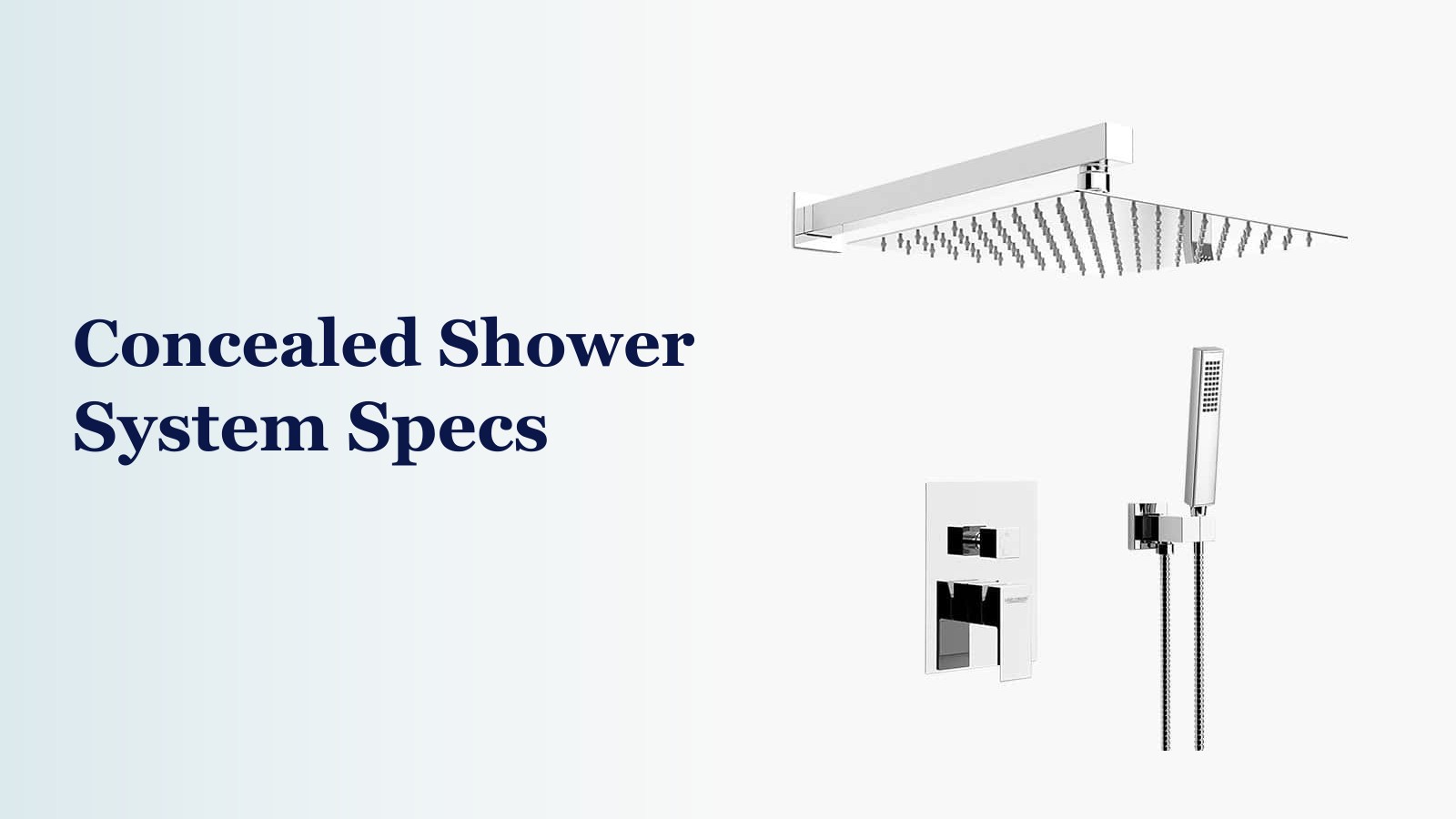
One real configuration makes the parts concrete. Leelongs model SH-44000-1166 lists a brass pressure-balance valve, 10-inch (about 25 cm) square rain head, hand shower, shower arm, holder, and 60-inch (about 152 cm) hose. Its product page identifies stainless steel, brass, and ABS in specific components.
| Published SH-44000-1166 detail | What the figure describes | What it does not establish |
| 10-inch rain head | Approximate face width | Delivered flow or spray force |
| 60-inch hose | Hand-shower hose length | Available water pressure |
| Brass pressure-balance valve | Listed valve type and material | Rough-in depth or trim compatibility with another model |
That distinction matters: visible dimensions describe the fixtures, while hydraulic and installation performance require a model-specific drawing or test result. A larger rain head does not itself prove a higher flow rate.
Valve and trim must belong to the same system
Pressure-balancing valves respond to changes in the relative hot and cold supply pressures. Thermostatic valves regulate the mix toward a selected temperature. A diverter performs a different job: it directs the mixed water to an outlet. Some products combine functions, while others use separate controls.
| Part | Main function | Compatibility question |
|---|---|---|
| Rough-in valve | Mixes and controls water behind the wall | Which cartridge and trim family fit this body? |
| Trim and handle | Provide the visible control interface | Is this trim approved for the exact valve model? |
| Diverter | Selects the outlet or permitted outlet combination | Which operating positions does this model provide? |
Trim fit is mechanical, not just visual. Manufacturer installation literature identifies compatible valve families and sometimes separate rough-in bodies for trims that look similar. A finish match therefore cannot establish that a handle will operate an existing in-wall valve.
Terms such as “thermostatic,” “pressure balance,” and “anti-scald” also describe different features. The exact cartridge and test documentation determine what a particular assembly does. Do not infer one feature from another label.
Finished-wall depth controls whether the trim fits
A concealed valve sits within a permitted installation-depth range. That range is measured relative to the finished wall face, not the open studs or masonry. Substrate, waterproofing, adhesive, and tile all change the final position of the trim plate.
If the valve is too deep, the handle or trim fasteners may not reach. If it projects too far, the plate may not sit against the tile. Some valve families offer extension kits, but availability depends on the exact valve and trim combination.
There is no useful universal rough-in depth for all concealed shower systems. The model drawing supplies its minimum and maximum positions, usually as a dimension or marked installation zone. The wall build-up must be compared with that range before the surface is closed.
Outlet logic changes the flow path
“Two-outlet” commonly means a fixed head and a hand shower. It does not say whether both can run together. A diverter may offer one outlet at a time or include a shared position. Its operating positions are a product specification, not an assumption from the number of ports.
| Configuration | Water path | Performance variable |
| Fixed head only | Mixed water goes to one outlet. | Flow at the head under the available supply pressure |
| Fixed head or hand shower | Diverter sends water to one selected outlet. | Flow and spray performance in each position |
| Fixed head and hand shower together | Supply is shared between two permitted outlets. | Combined flow and the flow left for each outlet |
When outlets operate together, the available flow is divided. Supply pressure may be unchanged, yet each spray can feel softer. The valve, diverter, hose, head design, and pipework add resistance. Our dual shower head system article examines switching and shared-flow behavior in more detail.
Water pressure needs measured flow data
Pressure, measured in psi or kPa, describes the water supply condition. Flow, measured in gallons or liters per minute, describes volume delivered. They are related but not interchangeable. A “high-pressure” description or a large head diameter gives neither a complete pressure curve nor a measured outlet flow.
The U.S. EPA WaterSense showerhead specification provides a useful example of how performance data is reported. A showerhead rated at a maximum of 2.0 gallons per minute must meet minimum-flow requirements at three flowing pressures. These are program thresholds, not measurements of a Leelongs model.
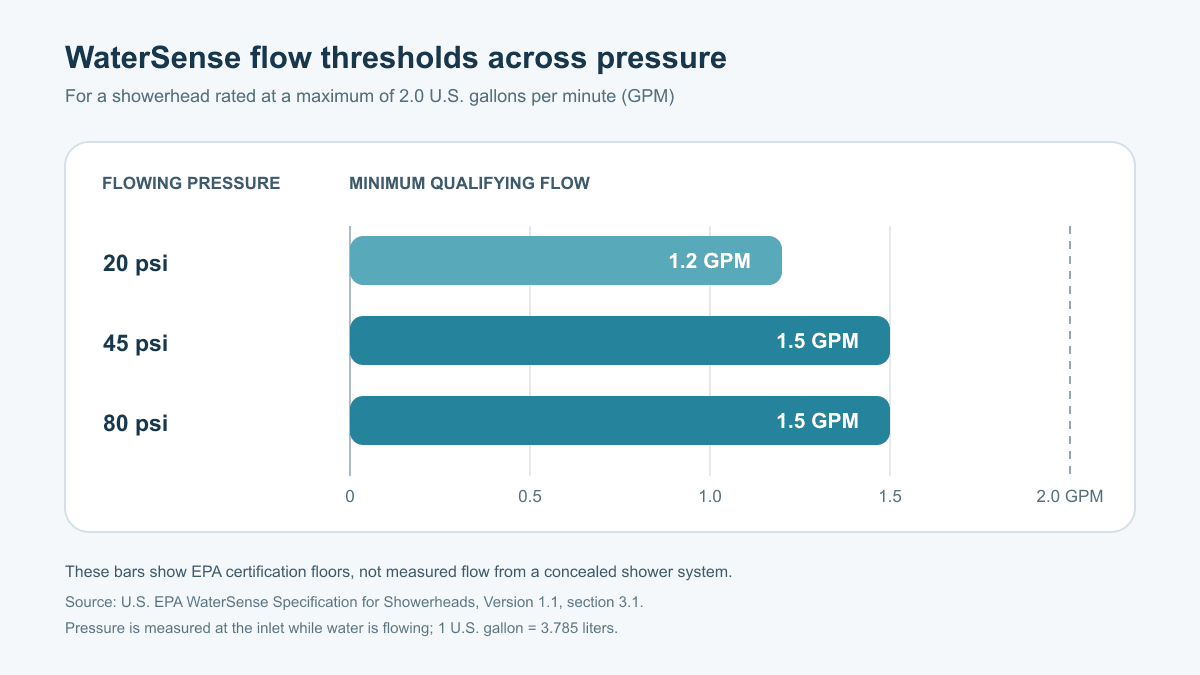
For a concealed assembly, head-only data still leaves open the effect of the valve, diverter, and any simultaneous outlet mode. A meaningful system result states which outlets ran, the flowing inlet pressure, and the measured flow at each outlet.
Serviceability depends on what is behind the plate
Many concealed systems permit cartridge service through the front trim opening. That does not mean every hidden component is reachable from the room. Access depends on the valve design, opening size, location of stops, and how the pipework was installed.
A worn cartridge can be a very different repair from a leaking connection inside the wall. The first may be replaceable after removing trim; the second may require access to the pipework. Product drawings and exploded parts views show which parts are designed for front removal.
Long-term service also depends on the exact valve family. Replacement cartridges, seals, and trim are model-specific. Keeping the valve and trim references with the bathroom records makes later repair or a cosmetic update much easier.
FAQs about Concealed Shower Systems
Is a concealed shower system always thermostatic?
No. Concealed describes where the working parts sit. Pressure-balancing and thermostatic controls are different valve options, and the selected model determines the temperature-control behavior.
Does a 10-inch rain head need a specific pressure?
The diameter alone cannot establish a pressure requirement. The head’s flow design and the complete system matter. Compare the model’s test conditions with measured site pressure and flow.
Can two outlets operate at the same time?
Only if the diverter and complete system provide a shared operating position. A two-outlet layout may instead switch between the fixed head and hand shower.
Can the trim be changed without opening the wall?
Sometimes. The new trim must fit the existing valve family, and the required parts must remain available. The finish or plate shape alone is not enough to confirm compatibility.
Explore concealed systems with Leelongs
We manufacture shower products and support model-specific product discussions for global buyers. See our concealed shower system range, then contact us for the drawings and specifications behind the model you are considering.