
A shower head flow restrictor limits water volume, but it is not automatically the cause of a weak shower. Check the inlet screen, hose, valve and upstream supply before changing it. For buyers, the restrictor must also match the SKU’s rated flow and destination requirements.
What a Shower Head Flow Restrictor Does
A flow restrictor reduces the amount of water that can pass through the shower head per minute. It may be a separate insert, a calibrated opening, a pressure-compensating component or part of an integrated inlet assembly.
The part helps a finished shower head stay within its declared flow rate. Good product design also considers spray force, coverage and performance across changing supply pressures instead of treating the restrictor as an isolated plastic disc.
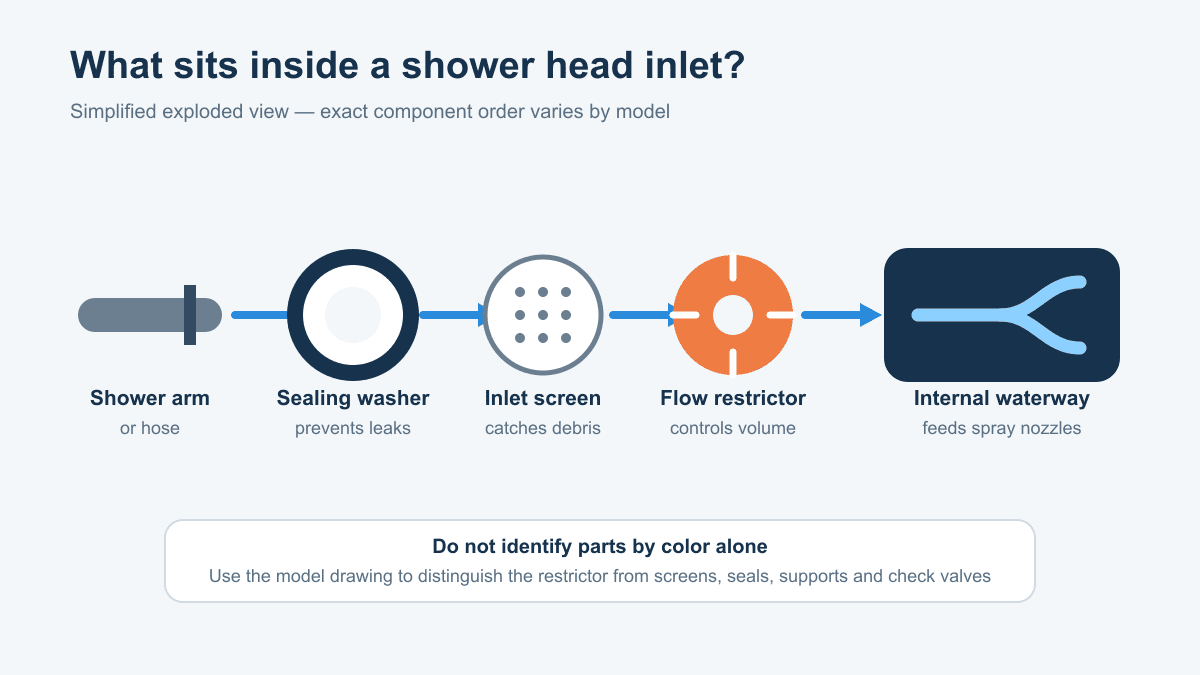
A restrictor controls flow; it does not create building pressure. Removing one can allow more water through, but it cannot repair a blocked valve, weak supply, kinked hose or undersized pipe.
Where Is the Flow Restrictor Located?
Many fixed and handheld shower heads place the flow-control component near the threaded inlet, behind the sealing washer or debris screen. Other products build it into a cartridge or internal waterway.
| Design | Typical form | Buyer implication |
| Fixed-orifice insert | Calibrated plastic or elastomer part | Control aperture, retention and assembly orientation |
| Pressure-compensating regulator | Flexible control element that responds to pressure | Test at every required flowing pressure |
| Integrated flow control | Geometry built into the inlet or cartridge | Do not treat it as a removable service part |
Color is not a reliable identifier. A visible piece may be a screen support, check valve, seal or connector. Disassembling an unknown component can create leaks or permanent damage.
Flow Restrictor vs Water Pressure
| Observed symptom | Likely area to inspect | Useful next check |
| Flow became weak suddenly | Screen, nozzles, washer or debris | Clean approved service parts and retest |
| Only the handheld is weak | Hand shower, hose or diverter branch | Compare flow from the bare hose |
| Shower arm flow is also weak | Valve, cartridge, pipework or supply | Continue diagnosis upstream |
| Flow changes when other fixtures run | Available building supply | Measure dynamic pressure and simultaneous demand |
Flow rate is volume per minute; pressure is force per area. A shower head can shape the available water into faster-feeling jets, but marketing language such as “high pressure” does not replace measured flow and pressure data.
Should You Remove a Shower Head Flow Restrictor?
Do not make removal the first response to weak flow. Clean the screen, confirm that the washer is seated correctly and compare flow before and after the head or hand shower.
In the United States, 10 CFR 430.32(p) sets a federal maximum of 2.5 GPM at 80 psi. It also requires a flow-restricting insert to be mechanically retained at manufacture, subject to a stated exception.
The EPA WaterSense showerhead program uses a maximum rated flow of 2.0 GPM and includes minimum-flow, spray-force, coverage, marking and certification requirements. State, local, project and retailer limits can be stricter.
Removing or altering the part can change the declared flow, invalidate test results, affect warranty coverage or make the product unsuitable for its destination. For production, certified or project-approved units, control changes through engineering and compliance review.
Diagnose Weak Flow Before Modifying the Part
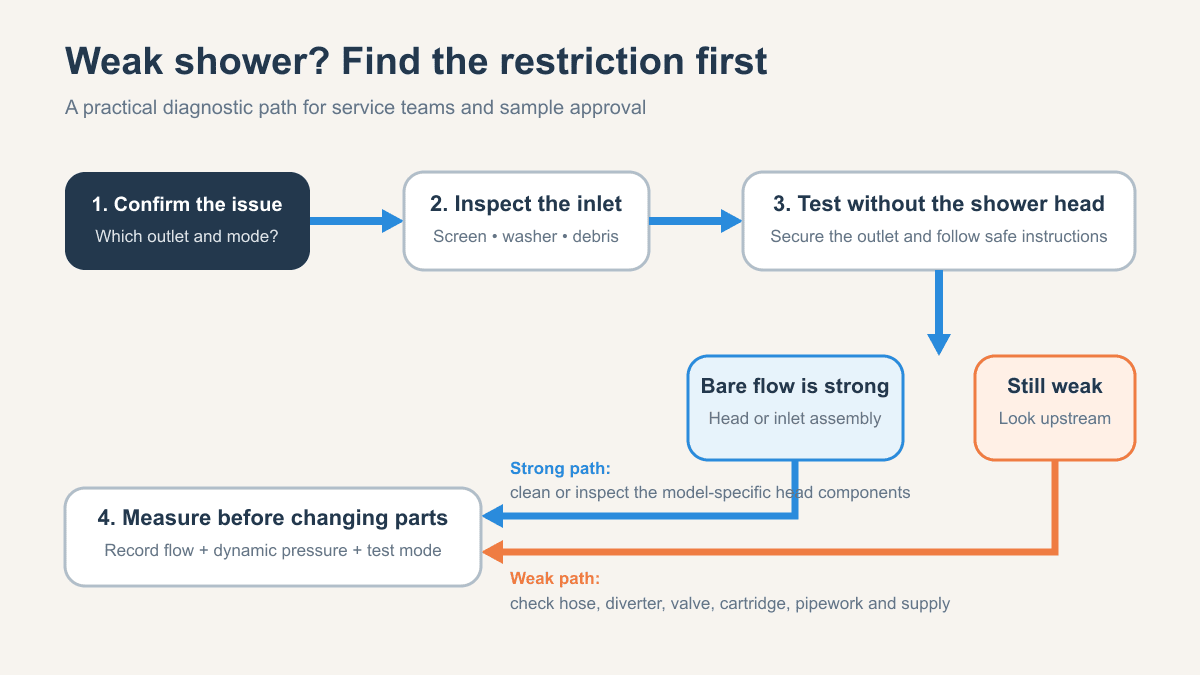
- Confirm the complaint: record the exact outlet, spray mode and conditions where low flow occurs.
- Inspect the inlet: check the screen, washer, visible debris and model-specific service parts.
- Isolate the outlet: safely compare flow from the shower arm or secured hose without the head attached.
- Check upstream components: review the diverter, cartridge, service stops, hose and supply when bare-outlet flow is weak.
- Measure, then decide: record flow and dynamic pressure before replacing any calibrated part.
For a broader troubleshooting sequence, see our low shower pressure guide.
B2B Flow Restrictor Specification Checklist
- Destination: country, state, retailer, project and certification requirements.
- Rated flow: target GPM or L/min plus the specified flowing-pressure conditions.
- Control design: fixed orifice, pressure-compensating regulator or integrated geometry.
- Retention: assembly method, tamper resistance and inspection standard.
- Mode coverage: test every spray setting and every permitted outlet combination.
- Performance: flow stability, spray force, coverage, noise and user handling.
- Traceability: part code, approved color, dimensions, supplier and revision level.
- Packaging: correct flow marking, destination labels and model-specific instructions.
Approve the restrictor together with the complete shower head. A substitute with the same visible size may use different material, aperture geometry or pressure response and can change finished-product performance.
During pilot production, sample units from different assembly times and verify the marked flow tier at the required pressures. Keep failed results, corrective actions and approved parts traceable to the purchase order so an undocumented insert change cannot spread across multiple markets.
FAQs about Shower Head Flow Restrictors
Does every shower head have a removable flow restrictor?
No. Some use a removable insert, while others integrate flow control into the inlet or internal cartridge. Check the exact model drawing or manufacturer instructions.
Can a clogged flow restrictor cause weak flow?
Debris can obstruct the inlet assembly, but the screen is often the first collection point. Clean approved service parts and measure again before replacing the calibrated control.
Does removing the restrictor increase water pressure?
It may increase outlet flow when the shower head is the restriction. It does not increase upstream supply pressure and will not solve a restricted valve or weak building supply.
Can buyers specify different restrictors for different markets?
Yes, but each version should be managed as a controlled SKU. Match the insert, product marking, test records and packaging to the intended destination.
Develop Your Flow-Controlled Shower Head Range
We have manufactured shower products since 2001 and support OEM and ODM projects with samples, drawings, custom packaging and function testing within our documented capabilities.
Explore our shower head range, then contact us with your destination, target flow, test pressure, spray format and order requirements.