Europe’s low rivers are a visible reminder that water cannot be taken for granted. Small household habits matter, but efficient bathroom products can make conservation easier every day. Here is how you can save water without turning a comfortable shower into a sacrifice.
Why Europe’s Low Rivers Make Water Conservation Urgent
In August 2026, Copernicus Sentinel-2 images showed exceptionally low water levels in the Loire, Po, Rhine and Danube. Exposed sandbanks and gravel bars made the effects of prolonged drought easy to see from space.
The consequences extend beyond the riverbank. The EU Agency for the Space Programme reported pressure on freight transport, industrial supply chains, irrigation, hydropower and power-station cooling.
No single household can restore a river. Yet millions of repeated decisions influence demand. Saving water at home also reduces the energy used to heat, pump and treat it. The most practical response combines better habits with fixtures designed to control unnecessary flow.
How to Save Water at Home: Simple Habits That Last
Effective water-saving tips should be easy enough to repeat. Start with the routines you perform every day, then make the efficient choice the automatic one.
| Daily habit | What to do | Why it helps |
| Take shorter showers | Set a timer or use one song as your guide. | Fewer running minutes mean less water and less water-heating energy. |
| Turn off the tap | Stop the flow while brushing, shaving or soaping your hands. | It prevents clean water from running unused. |
| Reuse suitable water | Collect rinse water for cleaning or watering non-edible plants when appropriate. | One supply can complete more than one useful task. |
| Repair leaks promptly | Check taps, hoses, valves and toilet cisterns. | Small, continuous losses accumulate quietly. |
| Run full loads | Use washing machines and dishwashers only when reasonably full. | You gain more cleaning from each cycle. |
Make conservation visible. Keep a shower timer near the bathroom, place a small container where reusable water is convenient to collect, and add leak checks to your monthly household routine. Simple cues are more reliable than relying on memory.
Save Water at the Source with Efficient Bathroom Products
Habits depend on attention. Efficient fixtures work whenever you use them. A coordinated bathroom can include a dual-flush or reduced-flush toilet, an aerated or sensor-controlled faucet, and a water-saving shower head with a suitable flow rate.
When comparing products, do not judge efficiency by appearance alone. Check the rated flow, applicable market requirements, spray coverage, cleaning needs, connection type and performance at the water pressure expected in the building.
- Water-saving toilets: control the water used for each flush and may offer separate flush volumes.
- Efficient faucets: use aerators, flow controls or timed operation to limit avoidable running water.
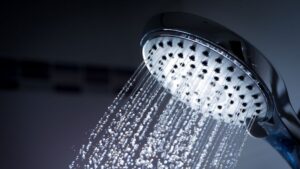
- Water-efficient shower heads: manage outlet size, spray pattern and flow so less water can still cover the body effectively.
For North American projects, the EPA explains that WaterSense-labelled showerheads must use no more than 2.0 gallons per minute and meet performance criteria for spray force and coverage. Requirements differ by market, so buyers should confirm the specification for each destination.
How Water-Saving Shower Head Designs Work
A low flow shower head is not simply a blocked outlet. Good design manages how water moves through the product. The objective is controlled flow, useful coverage and a spray that matches the intended installation.
Stainless Steel Faceplate and Overhead Showers
A stainless steel faceplate can use precisely arranged, fine water outlets to distribute the spray across a broad area. Outlet diameter, number and pattern all influence perceived coverage, flow behaviour and the ease of cleaning the faceplate.
This approach is well suited to slim overhead and handheld formats. The SH-1531, for example, uses a stainless steel shower panel with precision laser spray holes, showing how fine outlets can be incorporated into a compact chrome design.
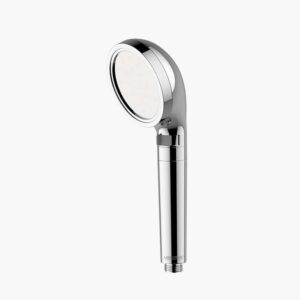
When filtration is also part of the brief, the SH-30021 combines a compact spray head with a 15-stage cartridge and universal G1/2 connection.
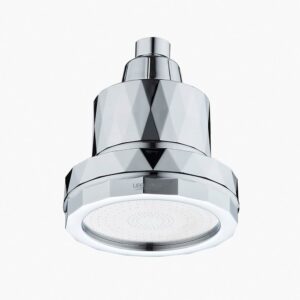
Flow-Control Shower Heads
A flow-control shower lets the user reduce or pause water at the hand shower during parts of the routine, such as shampooing or soaping. This places control within easy reach instead of asking the user to adjust the main mixer repeatedly.
The control should feel clear and predictable. Product teams also need to consider local plumbing rules, pressure conditions and whether a pause function stops flow completely or intentionally leaves a small trickle.
Control can also refer to spray selection rather than shutoff. For example, the SH-2978 uses a rotate-to-switch panel for five spray modes.
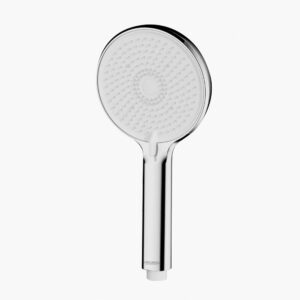
The SH-2986 provides six modes in a round handheld design. Both list 1.8 and 2.5 GPM configurations. These two models are relevant examples of user-selectable spray control.
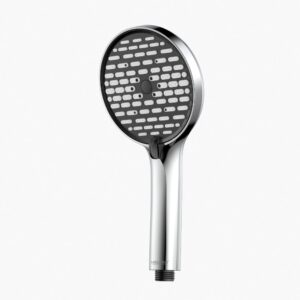
Water-Saving Washers and Flow Regulators
A water-saving washer is a compact component installed between the shower head and hose. Its internal structure regulates the available water passage, helping manage flow as supply pressure changes. It can be a practical option when the shower assembly must retain its external form.
Buyers may also search for this component as a shower head flow restrictor or flow regulator. Its performance depends on the insert design, inlet pressure, connection and complete shower system, so samples should be tested under representative conditions.
| Solution | Main principle | Useful for |
| Stainless steel faceplate | Fine, arranged outlets distribute the spray. | Slim overhead showers and broad spray formats. |
| Flow-control shower | User adjusts or pauses flow at the hand shower. | Convenient control during shower routines. |
| Water-saving washer | Internal geometry manages the passage area. | Compact flow regulation at the hose connection. |
Choosing Leelongs Means Choosing Responsible Design
Founded in 2001, Leelongs has designed, manufactured and exported shower products for global B2B customers. Our portfolio covers shower heads, shower systems, filtered shower products, faucets and related accessories, with OEM and ODM support for brands and distributors.
Leelongs develops shower products for brands, distributors and project buyers that need efficiency to be considered from the beginning. Our work can cover spray layout, material selection, flow-control options, connection details and product testing for the intended market.
Water conservation becomes meaningful when responsible habits and thoughtful products work together. Explore Leelongs shower solutions, or contact our team to discuss a water-efficient shower project for your market.
FAQs about Water-Saving Shower Heads
What is a low flow shower head?
It is a shower head engineered to operate at a lower rated flow than a conventional alternative. Designs may use smaller outlets, optimised spray patterns, air mixing or a flow-regulating component. Always compare the stated flow under the specified test pressure.
Will a water-saving shower head always feel weak?
No. Flow volume is only one part of the experience. Outlet geometry, spray coverage, droplet pattern and supply pressure also matter. The right design aims to use water more effectively, but performance should be verified in the conditions where the product will be installed.
Can I add a water-saving washer to an existing shower?
Often, a compatible washer or regulator can be installed at the connection between the hose and shower head. Confirm the thread, seal, pressure range and desired flow first. Installation must follow the component supplier’s instructions and local plumbing requirements.
What should business buyers specify to a shower manufacturer?
Share the destination market, target flow, test pressure, shower type, connection standard, materials, spray expectations and any required compliance programme. These details help the manufacturer recommend a suitable structure instead of treating “water saving” as a vague label.