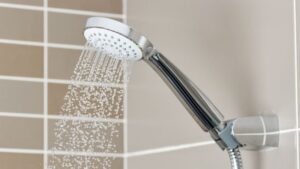
Why the Shower Head Holder Matters
A holder parks a handheld shower securely and keeps the spray direction usable. The right design also improves reach, height control, bathroom organization, and the finished look of a shower set.
For buyers, this small component can influence installation time, returns, replacement demand, and perceived product quality. A bracket that slips, rotates under load, or mismatches the wall can undermine an otherwise good shower system.
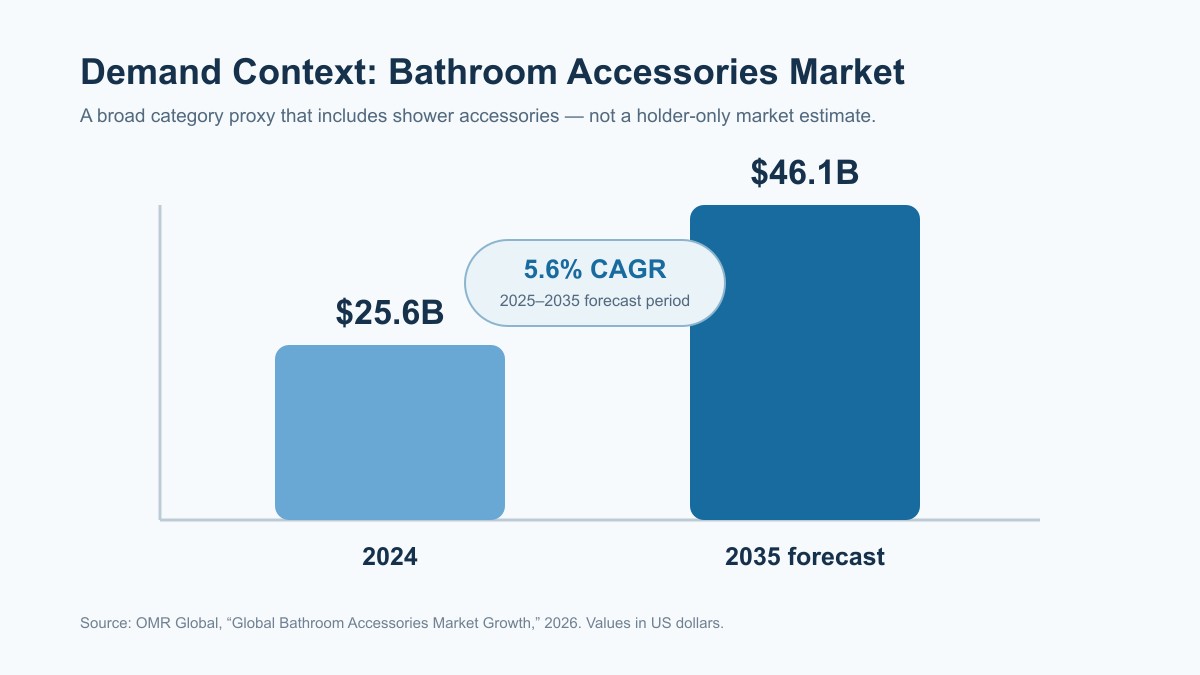
Reliable public data for shower head holders alone is limited. As a demand proxy, OMR Global valued the broader bathroom accessories market at US$25.6 billion in 2024 and forecast US$46.1 billion by 2035. Its scope includes shower accessories.
Compare Shower Head Holders by Installation Method
| Installation type | Best fit | Main advantage | Buyer caution |
| Screw-fixed wall mount | Hotels, new construction, long-term installations | Stable, permanent fixing for regular use | Specify wall substrate, anchors, hole spacing, and waterproof sealing method |
| Slide-bar holder | Family, hospitality, and multi-height bathrooms | Moves vertically and often adjusts spray angle | Confirm rail diameter, holder opening, lock mechanism, and replacement procedure |
| Adhesive holder | Retrofits, rental properties, fast renovations | No drilling and quick placement on approved surfaces | Check surface preparation, curing time, temperature limits, and stated load |
| Suction holder | Temporary or repositionable use on smooth walls | Creates a vacuum after air is expelled; easy to remove | Not suitable for porous, uneven, or heavily textured surfaces |
| Magnetic holder | Frequent docking and quick-release applications | Fast attachment between the holder and magnetic base | Verify magnetic compatibility, holding force, adhesive base, and corrosion protection |
| Clamp-on or shower-arm mount | Existing rails or shower arms where wall work is restricted | Uses existing hardware and may avoid drilling | Confirm tube diameter, anti-slip liner, clearance, and hose pull direction |
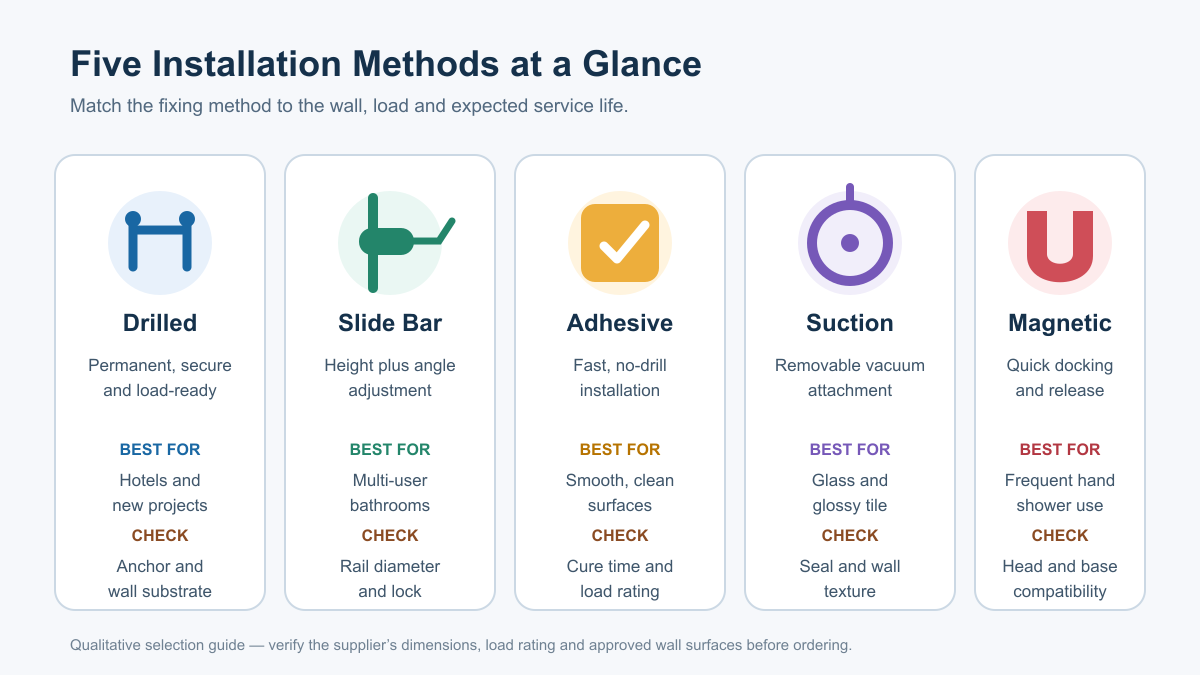 Qualitative selection guide. Verify each supplier’s dimensions, load rating, and approved wall surfaces before ordering.
Choose the Right Holding and Adjustment Style
Installation method explains how the bracket meets the wall. Holding style explains how users position the hand shower. Treat these as separate specifications.
| Holding style | What it does | Best use case |
| Fixed cradle | Holds one preset position | Budget ranges and uniform bathroom layouts |
| Angle-adjustable holder | Tilts or pivots the shower head | Mixed user heights and targeted spray direction |
| Extension arm or tube | Moves the docking point outward or to a more reachable position | Deep tubs, limited reach, or non-standard plumbing layouts |
| Height-adjustable rail slider | Moves along a vertical bar and may also pivot | Family bathrooms, senior-friendly layouts, and hospitality projects |
Do not label a holder “universal” without dimensions. Rail sliders commonly depend on rail diameter, while wall cradles must fit the hand shower handle or hose-end geometry.
Decide Between Basic and Integrated Designs
A basic holder focuses on secure docking and keeps the bill of materials simple. It suits price-sensitive ranges, replacement programs, and projects where storage already exists.
Integrated models combine the cradle with hooks, a small tray, hose management, a water outlet, or other useful functions. They can raise perceived value and reduce wall clutter, but every added feature introduces another load, dimension, and cleaning requirement.
- Use basic designs for standardized projects, spare parts, and entry-level retail programs.
- Use integrated designs when shelf space is limited or differentiation matters.
- Request usability samples when a hook, tray, pivot, or release action affects daily handling.
Use This B2B Shower Head Holder Checklist
| Question | Why it changes the specification |
| What is the wall surface? | Glass, smooth tile, textured tile, stone, acrylic, and painted walls require different fixing methods. |
| How heavy is the shower head? | Head weight, hose pull, and water movement affect the real working load. |
| What dimensions must fit? | Confirm handle taper, cradle opening, rail diameter, hole spacing, and available wall clearance. |
| Will users adjust it frequently? | Frequent movement favors tested pivots, positive locks, and easy-release mechanisms. |
| Is installation permanent? | Projects usually favor drilled stability; rentals and retrofits may favor no-drill options. |
| Who will use the shower? | Children, older adults, seated users, and tall users may need greater height and angle range. |
| What finish and material are required? | Match the shower set, target price, wet-area durability, and cleaning expectations. |
| Are extra functions useful? | Hooks and trays should solve a real layout problem, not add unnecessary complexity. |
| How will quality be approved? | Agree on samples, fit checks, adjustment-cycle checks, finish inspection, packaging, and replacement parts. |
Leelongs Recommendations by Buyer Type
| B2B buyer | Recommended direction | What to prioritize |
| Hotel or property project | Screw-fixed, angle-adjustable holder such as SH-7504 | Stable installation, repeatable appearance, hardware, and maintenance access |
| Retailer or distributor | A tiered range: basic fixed, adjustable wall mount, rail slider, and no-drill option | Clear compatibility labels and distinct price points |
| E-commerce or private-label brand | Adjustable or integrated designs with obvious visual benefits | Installation clarity, packaging protection, finish consistency, and spare pads or hardware |
| Rental or renovation channel | Adhesive, suction, or clamp-on models for approved surfaces | No-drill setup, removal method, realistic load guidance, and surface warnings |
| Shower-system manufacturer | Holder engineered around the selected hand shower, hose, rail, and finish family | System compatibility, color matching, OEM packaging, and repeatable QC |
Our shower holder range includes adjustable wall-mounted options in high-strength ABS with multiple chrome-finished designs. For OEM or project sourcing, approve the holder together with the actual hand shower and hose rather than as an isolated part.
FAQs about Shower Head Holders
Are shower head holders universal?
No. Check the cradle opening, shower handle shape, rail diameter, hole spacing, wall clearance, and intended load before ordering.
Which holder works best on smooth tile or glass?
Adhesive and suction holders can suit smooth, clean, non-porous surfaces when the supplier approves that surface. Never assume one fixing method fits every coating or texture.
When should a buyer choose a slide-bar holder?
Choose it when users need regular height changes. Confirm the rail diameter and locking method, because replacement sliders are not automatically interchangeable.
What should be tested before a bulk order?
Test fit, working load, hose pull, repeated adjustment, wet-surface installation, finish quality, and packaging. Use the intended shower head, wall sample, and installation hardware.
Build the Right Shower Holder Range with Leelongs
We design and manufacture shower products and accessories for international B2B customers, with product development, functional testing, finish inspection, packaging verification, and OEM/ODM support.
Explore our shower head holder products, then contact us with your market, wall type, hand shower dimensions, target price, and order requirements for a focused recommendation.